
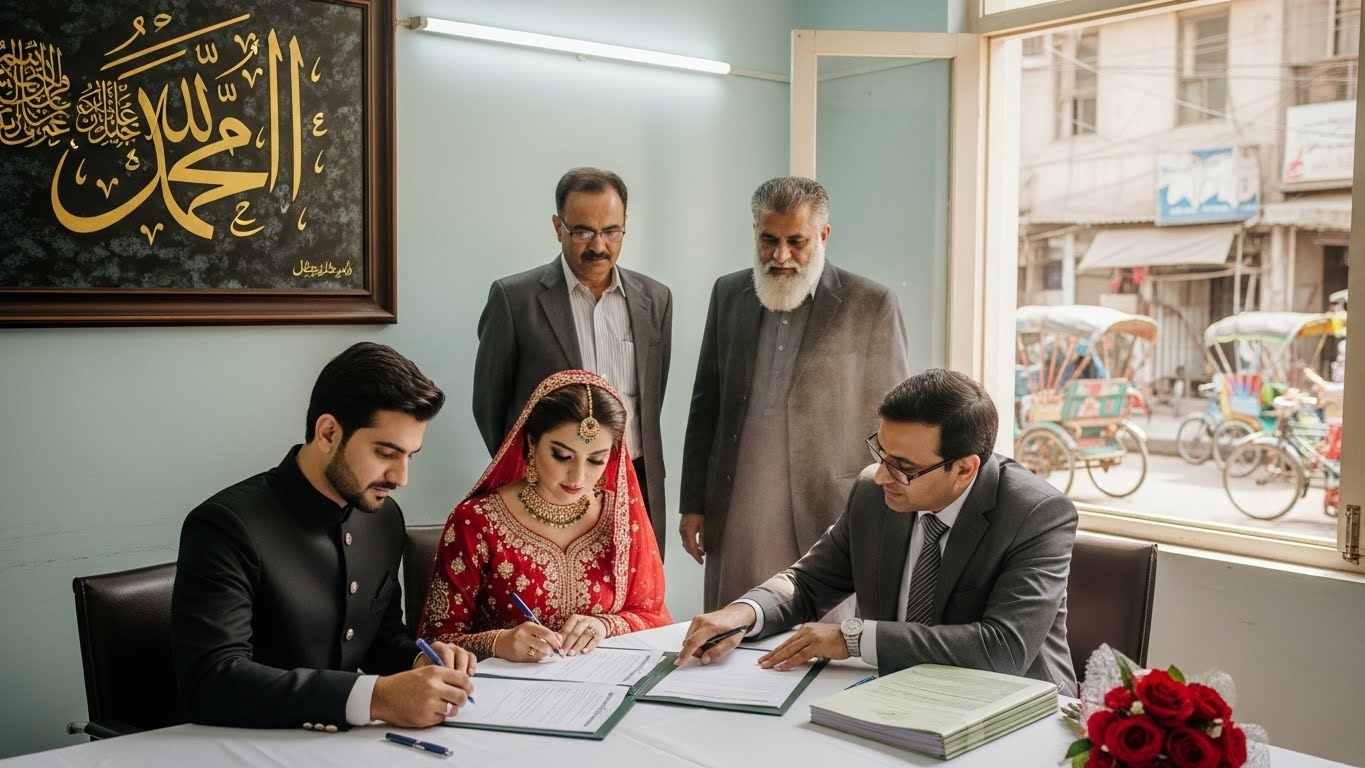

Court marriage in Karachi has become an increasingly preferred option for couples seeking a lawful, transparent, and secure way to solemnize their marriage. In Pakistan, especially in urban centers like Karachi, court marriage offers legal protection, privacy, and swift documentation. Many couples also want clarity on court marriage fees, court marriage in Islam, and court marriage rules in Pakistan, including explanations in Urdu.
This guide is written in simple English, keeping a Grade 7 reading level, while still providing authoritative and legally accurate information. Whether you are planning a marriage or researching the law, this article covers everything you need to know
What Is Court Marriage in Karachi?
Court marriage in Karachi refers to a legally recognized marriage solemnized before a Magistrate or Family Court Judge under Pakistani law. It usually involves a Nikah performed according to Islamic principles, followed by official registration.
Unlike traditional ceremonies, court marriage focuses on legality rather than cultural rituals. Couples often choose this method to avoid social pressure, family disputes, or unnecessary expenses. Importantly, court marriage in Karachi is fully valid under Pakistani law.
Legal Framework of Court Marriage in Pakistan
Muslim Family Laws Ordinance
Court marriage in Pakistan is governed primarily by the Muslim Family Laws Ordinance, 1961. This law ensures that marriages are conducted with free consent, proper witnesses, and lawful registration.
The ordinance protects the rights of both spouses, especially women, by ensuring transparency and enforceability of marital rights.
NADRA & Marriage Registration
After the Nikah, the marriage is registered with local Union Councils and later linked with NADRA records. This step is essential for legal proof. You can learn more from the official NADRA website:
External Link: https://www.nadra.gov.pk
Court Marriage in Islam: Shariah Perspective
Many people ask whether court marriage in Islam is permissible. The short answer is yes.
Nikah Conditions in Islam
According to Islamic law, a Nikah is valid if the following conditions are met:
- Free consent of both bride and groom
- Presence of two adult Muslim witnesses
- Offer (Ijab) and acceptance (Qubool)
- Dower (Haq Mehr)
Court marriage fulfills all these requirements when conducted properly.
Validity of Court Marriage in Islam
Court marriage in Islam is valid as long as it meets Shariah conditions. Islam does not mandate lavish ceremonies. Therefore, a simple Nikah conducted in court is completely lawful and religiously acceptable.
Court Marriage Rules in Pakistan
Understanding court marriage rules in Pakistan is essential to avoid delays or legal issues.
Age Requirement
- Groom: Minimum 18 years
- Bride: Minimum 18 years (as per Sindh Child Marriage Restraint Act)
Consent & Free Will
Both parties must appear before the court willingly. Forced marriages are illegal and punishable under Pakistani law.
Witnesses & Documentation
At least two witnesses are required, along with valid CNICs.
Court Marriage in Pakistan Rules in Urdu (Overview)
عدالتی شادی کے قوانین پاکستان میں واضح طور پر بیان کیے گئے ہیں۔
اہم نکات درج ذیل ہیں:
- لڑکا اور لڑکی کی رضامندی ضروری ہے
- عمر 18 سال یا اس سے زیادہ ہونی چاہیے
- نکاح رجسٹریشن لازمی ہے
- دو گواہوں کی موجودگی ضروری ہے
This overview helps Urdu-speaking families understand the legal process clearly.
Step-by-Step Procedure of Court Marriage in Karachi
Court marriage in Karachi follows a straightforward process:
- Visit a Family Court or authorized lawyer
- Submit CNIC copies and photographs
- Verification of age and consent
- Nikah ceremony conducted
- Signing of Nikahnama
- Marriage registration
The entire process often completes within a single day.
Court Marriage Fees in Karachi
One of the most searched topics is court marriage fees. While costs may vary, here is a general estimate:
| Item | Estimated Cost (PKR) |
|---|---|
| Court Fee | 2,000 – 5,000 |
| Lawyer Fee | 10,000 – 25,000 |
| Nikah Registrar | 2,000 – 5,000 |
| Documentation | 1,000 – 3,000 |
Overall, court marriage in Karachi is affordable compared to traditional weddings.
Required Documents for Court Marriage
You will typically need:
- Original CNICs (Bride & Groom)
- Passport (if applicable)
- Passport-size photographs
- Divorce decree (if previously married)
- Witness CNICs
Having complete documents speeds up the process.
Advantages of Court Marriage
Court marriage offers many benefits:
- Legal security
- Quick process
- Low cost
- Privacy
- Protection against forced marriage
Because of these advantages, court marriage in Karachi continues to gain popularity.
Common Myths & Misconceptions
Many believe court marriage is un-Islamic or illegal. This is false. Others think family consent is mandatory. Legally, only the consent of the bride and groom is required.
Such myths often discourage couples unnecessarily.
Conclusion
Court marriage in Karachi is a lawful, Islamic, and practical solution for couples seeking a secure marriage process. With clear court marriage rules in Pakistan, reasonable court marriage fees, and full compliance with court marriage in Islam, this option provides peace of mind and legal protection. By understanding the procedure and requirements, couples can confidently take this important step toward a lawful and respectful union.
FAQs
1. Is court marriage legal in Karachi
Yes, court marriage in Karachi is fully legal under Pakistani law.
2. What are the court marriage fees in Karachi?
Court marriage fees generally range between PKR 15,000 to 35,000.
3. Is court marriage allowed in Islam?
Yes, court marriage in Islam is permissible if Nikah conditions are fulfilled.
4. Can parents stop a court marriage?
No, if both adults consent, parents cannot legally stop it.
5. How long does court marriage take?
Usually, the process is completed within one day.
6. Are court marriage rules in Pakistan available in Urdu?
Yes, court marriage in Pakistan rules in Urdu are available through legal resources and courts.